AI Fashion Campaigns: How Brands Can Create Campaign-Ready Content Without a Traditional Shoot
Learn how AI fashion campaigns work, from one product image to a full lookbook, and where traditional photoshoots still make sense.
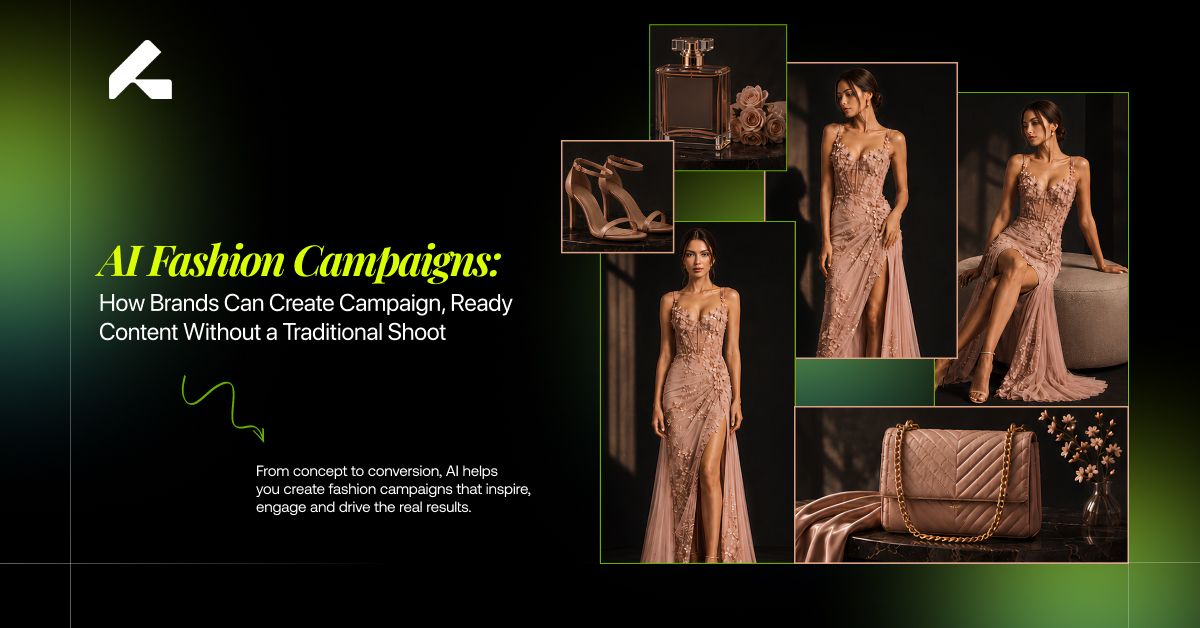
A traditional fashion campaign follows a long, expensive chain: book models, hire a photographer, secure a studio or location, arrange styling and hair and makeup, coordinate a full crew, shoot for a day, then retouch and revise afterward. Every new concept usually means repeating most of that chain from scratch.
What if a single product image could become the starting point for an entire campaign instead?
What Is an AI Fashion Campaign?
An AI fashion campaign uses generative AI to create on-model product imagery, editorial scenes, lifestyle shots, multiple poses and compositions, seasonal concepts, social creatives, lookbook visuals, and even short campaign videos, all built from existing product images rather than a physical shoot. AI isn't replacing creative direction here, it's changing how that direction actually gets produced.
What You Can Create With an AI Fashion Campaign
- Campaign hero images for homepages, ads, and launches.
- On-model product imagery showing clothing consistently across multiple pieces.
- Lifestyle and editorial scenes placing a collection into different environments.
- Social content with multiple crops, poses, and concepts for Instagram, TikTok, and Pinterest.
- Lookbooks built around one consistent visual identity.
- Fashion video, turning campaign stills into short promotional clips.
Why Traditional Fashion Campaigns Get Expensive Fast
The cost stacks up from model fees, studio or location rental, photographer and crew, hair and makeup, styling, travel, equipment, retouching, and the real possibility of a reshoot. But cost isn't the only issue. The bigger constraint is speed and flexibility: if you need ten new concepts after the shoot wraps, that generally means booking an entirely new production cycle.
AI Fashion Campaigns vs. Traditional Shoots
| Traditional Shoot | AI Fashion Campaign |
|---|---|
| Physical location | Generated environment |
| Model booking | AI-generated or selected model |
| Fixed shoot day | Generate as needed |
| Limited variations | Many creative variations |
| Expensive reshoots | Regenerate instead |
| Large production team | Smaller workflow |
| Physical samples required | Product image serves as reference |
This isn't a case for AI being universally better. Traditional photography still earns its place for high-end editorial campaigns, exact physical representation, complex garment detail, major brand campaigns, and situations where physical materials genuinely need to be captured precisely.
How to Build an AI Fashion Campaign, Step by Step
1. Start with a clean product image. The source image matters more than anything downstream, since everything else builds on it.
2. Choose or create your model. Define age, look, style, gender, appearance, and brand fit before generating anything.
3. Establish the creative direction. Mood, lighting, color palette, camera style, composition, and editorial tone all need deciding upfront.
4. Choose the environment. Studio, street, beach, urban, luxury interior, or a minimalist setting, whatever fits the collection.
5. Generate multiple poses and angles. The goal is a campaign, not one isolated hero shot.
6. Maintain consistency. Same model, same garment, same brand aesthetic, color treatment, environment style, and lighting direction across every image.
7. Create supporting content. Turn the core campaign into Instagram posts, Reels, Pinterest visuals, website banners, lookbook pages, paid ads, and product-page imagery.
The Biggest Challenge: Consistency
Generating one impressive AI fashion image isn't particularly hard anymore. The genuinely difficult problem is generating twenty images that clearly look like they belong to the same campaign. That means holding the same face, the same garment details, fabric texture, logos, colors, body proportions, lighting, and background continuity across every single image in the set. A campaign where the model subtly shifts or the garment color drifts from shot to shot reads as unfinished no matter how good any individual image looks on its own.
How Brands Actually Use AI Fashion Campaigns
- New collection launches, building campaign assets before a full-scale production.
- Seasonal campaigns, summer, winter, Eid, Christmas, Valentine's.
- Social media testing, trying multiple creative directions before committing budget.
- Paid advertising, generating variations for different audiences and placements.
- E-commerce catalogs, expanding basic product photos into on-model and lifestyle imagery.
- Small fashion brands, producing professional-looking campaigns without a large production infrastructure.
From One Product to an Entire Campaign
The real value shows up in the full chain a single image can become: product → model → environment → poses → campaign → social → video. One clean product photo, handled through a consistent workflow, can carry an entire campaign across every channel a brand actually uses, rather than requiring a separate production cycle for each one. For more on how this foundation works, see our guide to AI product photography.
When Should You Use AI vs. Traditional Photography?
Lean on AI when you need speed, creative exploration, campaign variations, social content, catalog scalability, multiple environments, or frequent updates. Lean on traditional photography when you need maximum physical accuracy, high-stakes editorial work, complex material detail, or certain premium campaigns. For most brands, a hybrid workflow, real photography for the highest-stakes hero images, AI for everything downstream, tends to be the strongest approach. Our full comparison of AI versus traditional photography covers this tradeoff in more depth.
How Much Does an AI Fashion Campaign Cost?
There's no single number, cost depends on the number of products and images, model requirements, resolution, whether video is included, how many variations you need, and the specific platform's pricing structure. For a full breakdown of what actually drives AI photography pricing, see our guide to how much AI product photography costs.
Limli: From One Upload to a Full Fashion Campaign
Limli takes this workflow a step further by letting brands start with a single product image, select or upload a model, choose a visual style and environment, and generate a consistent set of campaign visuals from there. The workflow is built specifically around the hardest part of this process, keeping the same model, product, and brand aesthetic consistent across an entire set, while extending into environments, variations, and video rather than stopping at a single generated image. To see the full range of best-performing platforms in this space, our guide to the best AI tools for product photography in 2026 is worth reviewing alongside this one.
Common Mistakes to Avoid
- Starting from a poor-quality product image.
- Letting the model change subtly between images.
- Ignoring garment accuracy in favor of a nicer-looking scene.
- Overusing unrealistic environments that undercut credibility.
- Generating random images with no unifying campaign concept.
- Forgetting brand consistency across the full set.
- Publishing AI imagery without a human review pass.
- Treating AI as a replacement for creative direction rather than a production tool.
Frequently Asked Questions
What is an AI fashion campaign?
A set of fashion visuals, on-model imagery, lifestyle scenes, social content, and sometimes video, generated with AI from existing product images rather than a traditional shoot.
How does an AI fashion campaign work?
It starts with a clean product photo, applies a chosen model and creative direction, and generates a consistent set of images and variations across environments and formats.
Can AI create fashion campaign images from one product photo?
Yes, a single accurate source image is typically enough to build an entire campaign's worth of variations.
Can AI keep the same model across multiple images?
Yes, though this consistency is exactly what separates a genuinely usable platform from one that only handles single, isolated generations well.
Can AI fashion campaigns include video?
Yes, many workflows can extend campaign stills into short promotional clips.
Are AI fashion campaigns cheaper than traditional photoshoots?
Often, particularly at scale, though the real comparison depends on usable output, not just the sticker price of either approach.
Is AI fashion photography suitable for e-commerce?
Yes, especially for expanding basic product photography into on-model and lifestyle content across a growing catalog.
Can AI replace traditional fashion photography entirely?
Not always. High-stakes editorial work and campaigns depending on exact physical material detail still benefit from a traditional shoot.
The Bottom Line
An AI fashion campaign isn't about generating one striking image, it's about building a consistent, connected set of visuals from a single product photo, then extending that same consistency across every channel a brand actually needs. The brands getting real value from this treat it as a repeatable production system, not a one-time creative experiment.