AI Product Photography vs Traditional Photography: Which Is Better for E-commerce?
AI product photography vs traditional photography, compare cost, speed, quality, and accuracy to find the right approach for your e-commerce catalog.
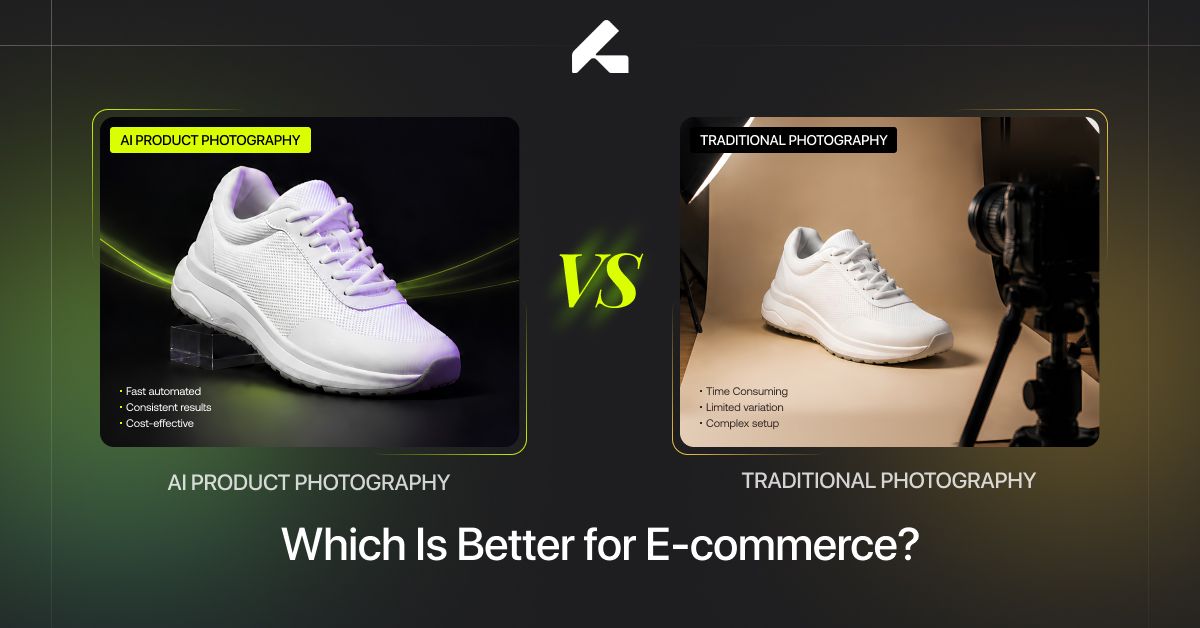
Quick Answer
AI product photography generates studio and lifestyle images from an existing product photo in seconds to minutes, and can significantly reduce the cost of producing additional product image variations compared to a traditional shoot, while scaling to hundreds of products without booking additional studio time. Traditional photography still wins for fine texture detail, complex multi-product compositions, high-stakes brand campaigns, and categories with strict regulatory imaging requirements. Most e-commerce brands get the best result from a hybrid approach: one accurate traditional or high-quality source photo per product, expanded into a wider range of variations through AI.
AI vs Traditional Product Photography: The Direct Comparison
| Factor | Traditional Photography | AI Product Photography |
|---|---|---|
| Typical cost per image | Higher, includes studio, photographer, and styling costs | Can meaningfully reduce cost per image once a source photo exists |
| Turnaround time | Days to weeks, including booking and editing | Minutes, often with instant regeneration |
| Studio or location required | Yes | No |
| Models required | Often, adds separate cost and scheduling | Frequently included in the generation itself |
| Consistency across a catalog | Varies by shoot, lighting, and photographer | Very high, same conditions applied to every image |
| Scalability to hundreds of SKUs | Difficult and expensive | Straightforward |
| Physical accuracy guarantee | Highest, the real product was photographed | Strong, but requires a human review step |
| Creative direction and storytelling | Full human control | Improving quickly, still more limited for complex narrative work |
Cost: Where the Real Gap Comes From
Traditional photography costs accumulate from several separate line items: studio rental, photographer fees, styling, models where needed, and retouching, each billed independently and multiplying with catalog size. A brand shooting new products every month effectively pays for a new production cycle every single time, regardless of how similar the setup is to the last one.
AI collapses most of that into a single, predictable cost per image or a flat subscription, since there's no studio to book and no crew to pay by the hour. The gap widens specifically as catalog size grows: photographing ten products is manageable under either approach, but photographing a few hundred products traditionally usually means multiple shoot days and a production budget that rivals a small marketing campaign on its own, while the AI cost per image stays essentially flat regardless of volume. This is one of the main reasons AI photography for e-commerce has moved from a novelty to a standard part of how growing catalogs get photographed.
Speed: Minutes vs. Weeks
A traditional shoot involves several sequential stages before a finished image exists: booking a photographer, coordinating a studio or location, potentially shipping products to the shoot site, the shoot itself, and then editing and revisions. Even a well-run process typically takes days to a couple of weeks from booking to delivery, and rush timelines usually cost more.
AI compresses that entire sequence into a single session. A product launching this week doesn't need to wait on a photography calendar, images can be generated, reviewed, and published the same day, which matters most during time-sensitive moments like a flash sale, a seasonal push, or a fast-moving product drop where a three-week photography lead time simply isn't compatible with the business.
Consistency and Scale
Traditional photography is vulnerable to a subtle but real problem: a catalog shot across different sessions, months, or photographers tends to drift. Lighting shifts slightly, color temperature varies, and background tone changes from one shoot to the next, differences a customer may not consciously name but will still notice when browsing a category page.
AI-generated images, by contrast, apply the same underlying conditions across an entire batch, which makes catalog-wide consistency far easier to maintain, and this advantage compounds directly with scale. A ten-product catalog is manageable either way. A few hundred products is where traditional photography's cost and logistics genuinely stop scaling, while AI-generated batches remain close to linear in both cost and turnaround.
Product Accuracy: The One Category Where Traditional Still Leads
This is the area competing guides tend to gloss over, and it's worth being direct about. A traditional photograph is, by definition, an image of the actual product. When you create product photography with AI, the result is a reconstruction built from a source photo and instructions, which means accuracy depends heavily on the quality of that source image and on a genuine review step before publishing.
The specific things worth checking on every AI-generated image before it goes live:
Shape and proportion, confirming the product hasn't been subtly stretched or distorted
Color accuracy, since generated lighting can shift a product's true color more than expected
Logo and packaging text, which are the most common place small AI artifacts show up
Texture and material representation, particularly for fabric, leather, or reflective surfaces
Consistency against your existing product listing, so a generated lifestyle image doesn't contradict your primary studio shot
None of this makes AI-generated imagery unusable, it makes a human quality check a required part of the process rather than an optional extra, the same way a traditional photo set still goes through a retouching and approval pass before publishing.
When Traditional Photography Is Still the Right Call
Fine texture and material detail. Jewelry facets, leather grain, fabric weave, and other detail-driven categories still benefit from a macro lens and controlled studio lighting capturing something AI can approximate but not always perfectly reproduce.
Complex multi-product compositions. A styled flat lay arranging several products with intentional spatial relationships is still a genuinely human skill, one that depends on physical arrangement in a way a single-product AI generation doesn't replicate easily.
High-stakes brand campaigns. A homepage hero banner, a major ad campaign, or a print placement seen by a large audience is usually worth the investment in precise human creative direction over every detail, the angle, the exact lighting, the specific mood.
Regulated or compliance-sensitive categories. Certain industries, particularly food, health, and cosmetics, may have specific requirements around product imagery that call for an actual photograph rather than a generated representation.
Your very first source photo. AI needs a real starting point. That original image can come from a simple, well-lit setup or a professional photographer, but a genuine photo of the product has to exist before AI can expand on it.
Low-volume sellers. If a business only launches a handful of products a year, the scalability and cost-per-image advantages of AI matter far less. A single well-planned traditional shoot may simply be the more practical choice when there's no ongoing volume to justify building an AI workflow around.
When AI Product Photography Is the Better Choice
Large or fast-growing catalogs, where the cost and logistics of traditional photography scale far faster than a business's actual photography budget.
Seasonal and campaign refreshes, since a holiday theme, a new colorway, or a promotional push can typically be generated in much less time than a full reshoot requires.
Creative testing, where trying several backgrounds, scenes, or compositions against each other to see what actually converts becomes far more affordable when generating variations costs meaningfully less than a physical reshoot.
Social media and advertising content, which demands a constant stream of fresh creative across multiple formats and platforms, something a traditional production schedule struggles to keep pace with indefinitely.
Fast-moving inventory, including dropshipping, print-on-demand, and any catalog that adds new SKUs weekly rather than seasonally.
Two Things Most Comparisons Leave Out
Commercial usage rights. Before relying on any AI tool for product imagery meant for ads, marketplaces, or print, it's worth confirming exactly what commercial usage rights come with the generated output. This varies by platform and matters more than it might seem, particularly for paid advertising and licensed marketplace listings.
The logistics you're actually removing. A traditional shoot often means physically shipping product samples to a studio or location, coordinating schedules across multiple people, and absorbing the overhead of that coordination on every single reshoot. AI removes that operational weight entirely, no shipping, no rebooking, no waiting on a shared calendar between a brand, a photographer, and a model. For a lean team, that overhead reduction is sometimes as valuable as the direct cost savings themselves.
The Real Answer: A Hybrid Workflow, Not a Winner
Treating this as a strict either-or choice misses how most e-commerce brands actually operate successfully. The most practical approach uses traditional photography to capture one accurate, well-lit source image per product, then uses AI to expand that single accurate photo into the full range of studio shots, lifestyle scenes, seasonal variations, and campaign assets a modern marketing calendar actually requires.
This is the kind of workflow tools like Limli are designed to support, taking an existing product photo as the starting point rather than requiring a new shoot for every variation.
Frequently Asked Questions
Is AI product photography as good as traditional photography?
For lifestyle scenes, studio backgrounds, and everyday catalog content, quality is generally comparable to professional photography once a strong source image is used. Traditional photography still holds an edge for fine texture detail, complex multi-product arrangements, and high-stakes creative direction.
How much cheaper is AI product photography than hiring a photographer?
Costs vary by tool and catalog size, but AI typically reduces the per-image cost of expanding a catalog's visual content significantly compared to booking a new traditional shoot for every variation, since studio, crew, and styling costs are removed from the equation entirely.
Can AI product photography completely replace a photographer?
Not entirely. A real source photo is still required as the starting point, and certain categories, fine jewelry, luxury goods, regulated products, and high-stakes brand campaigns, still benefit from traditional photography's precise physical accuracy and creative control.
How fast is AI product photography compared to a traditional shoot?
AI-generated images are typically produced in minutes, compared to days or weeks for a traditional shoot once booking, shooting, and editing are all accounted for.
Does AI product photography work for large catalogs?
Yes, this is one of its strongest use cases. AI can scale to hundreds of products while meaningfully reducing the cost and time a traditional approach would require at the same volume.
Can AI preserve my product's logo and packaging accurately?
Generally yes, though this is one of the most important things to check on every generated image, since small distortions in text or logos are the most common accuracy issue worth catching before publishing.
Can I use both AI and traditional photography together?
Yes, and this is genuinely the most common and most practical approach: a traditional or high-quality source photo per product, expanded into AI-generated variations for everything that follows.
Conclusion
The real question isn't whether AI product photography or traditional photography wins outright, it's which parts of your visual content actually need a human behind the camera, and which parts just need to be produced quickly, consistently, and at scale. Traditional photography still earns its place for the images a brand can't afford to get even slightly wrong. AI earns its place everywhere else, the lifestyle variations, the seasonal refreshes, the sheer volume a modern marketing calendar demands.
Whichever mix ends up making sense for your catalog, tools like Limli exist to support that hybrid approach, using the product photos you already have as the foundation for the additional visuals your marketing calendar needs.